New test standard for refrigerated lockers
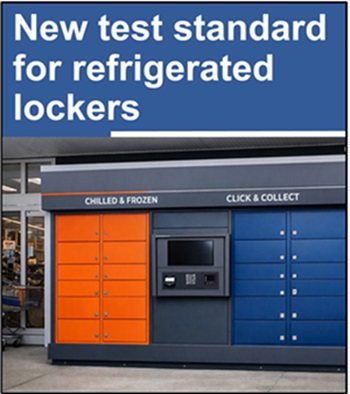
A new test standard covering refrigerated food lockers has just been approved at the Final Draft International Standard (FDIS) stage. This is the final approval stage before the publication stage. The standard entitled "Refrigerated food lockers — Thermal and energy performance, ratings, environmental test conditions and associated testing methods" covers food lockers intended for temporary cold storage of chilled or frozen foods until the final collection by the consumer.
Refrigerated lockers have increased in use as more consumers order food online and want the flexibility to be able to collect whenever convenient. The lockers use digital PIN codes, QR codes, or smartphone apps for secure anytime customer retrieval of their food order.
The global market for food lockers is predicted to increase and have a value of $343.26 million by 2035 (with a Compound Annual Growth Rate (CAGR) of 3.72% over the 2026-2035 period). In food retail, the dominant markets (in terms of market value) are currently the USA, China, Germany, Japan and France with the rest of Europe rapidly growing. Lockers are becoming a greater part of supermarket logistics, with over 65% of grocery chains integrating lockers into their food chains. As well as in traditional supermarkets, lockers may be used in quick-service restaurants and dark stores[1].
The new locker test standard has some similarities with EN ISO 23953 in that it has similar temperature classifications, test room design and operation and instruments and instrument accuracies. Test room climate classes mimic EN ISO 23953 but add extra classes for operation of the lockers at low temperatures. These new classes are labelled as -3, -2 and -1 and operate at dry bulb temperatures of -22, -7 and 5°C respectively. All the new classes require an air velocity of 1-3 m/s at the internal environment monitoring point. This is to simulate the impact of lockers that are located outdoors. In terms of loading the lockers, the same M-packs (temperature measurement packs) as in EN ISO 23953 are used, but polystyrene blocks are also allowed for the additional loading. Positioning of the M-packs depends on the air flow in the locker. Otherwise, the actual test regime is very similar to EN ISO 23953 but without any door openings. Measurement of energy consumption is the same as in EN ISO 23953. The metric used to assess specific energy consumption is net volume (rather than display area in EN ISO 23953) which is logical as it defines the volume of product that can potentially be stored in a locker.
Now that a test standard is about to be published, does that mean that lockers may eventually be energy labelled? In the impact assessment on the Ecodesign regulations for refrigerating appliances with a direct sales function, we reported that new categories of equipment such as food lockers are being considered. (RD&T Ecodesign newsletter). By having a test standard this moves the energy labelling process further forward. However, the piece of information that is still lacking is data on the temperature and energy consumption performance and associated net volume of lockers to enable minimum energy performance standards (MEPS) and labels to be created.
Currently testing of lockers is a new area for RD&T. However, as there are so many similarities with EN23953 it is simple for us to test lockers to all the indoor conditions in the new standard. If you would like further information on testing lockers, please get in touch with Judith Evans (j.a.evans@rdandt.co.uk).
[1] https://www.industryresearch.biz/market-reports/food-lockers-market-101714