Ecodesign/Energy Labelling Review
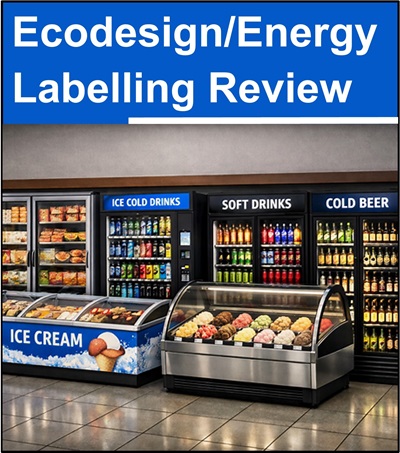
The European Commission has been carrying out an impact assessment on the Ecodesign regulations for refrigerating appliances with a direct sales function. This is led by the Directorate-General for Energy (DG ENER) and is carried out by a consortium of consultants. The work covers Commission Regulation 2019/2024 of 1 October 2019 laying down Ecodesign requirements for refrigerating appliances with a direct sales function, and Commission Delegated Regulation (EU) 2019/2018 of 11 March 2019 regarding energy labelling of refrigerating appliances with a direct sales function.
These Regulations cover five types of appliances: supermarket cabinets (refrigerators and freezers), ice-cream freezers, refrigerating vending machines, gelato-scooping and beverage coolers.
The Commission regularly reviews Ecodesign Regulations to assess their success, whether they should be updated to reflect market changes and if they still identify the best performing products. This process began in 2025 and will continue until 2027 (with outline publication date of 2029). A public consultation has already been initiated, and an on-line and in person information meeting is due to be held on 18 June 2026 to present information. It is stated that the meeting will focus on the evaluation findings, the problems, the problem drivers, policy options and the upcoming impact assessment.
To date the key finding from the study is that the Regulations have already achieved the original 2030 projections for energy savings. Stakeholders are supportive of labels, and the labels have driven improvements in the energy efficiency of products, although this has varied between categories. Since 2014 the Energy Efficiency Index (EEI) has significantly reduced for many product types with glass door cabinet now dominating the market. Natural refrigerants also dominate sales weighted sales data with 90% of cabinets sold in 2024 operating using a natural refrigerant. New categories for refrigerated food lockers (for ‘click and collect’ services outside supermarkets); ‘smart refrigerators’ (for selling snacks and beverages); and pozzetto (method for storing and displaying artisan gelato) storage cabinets for gelato are being considered.
Several issues such as the comparison between plug-in and remotely operated cabinets, incentives to increase glazing to increase Total Display Area (TDA) and the validity of the EPREL data are highlighted and will be discussed. In addition, there is a proposal to expand circularity and recyclability of several components that will be considered in the future.
A number of other minor issues and clarifications are also being considered such as chest freezers with opaque lids, cabinets that do not fit within any classification, cabinets that can be classified under several categories and inclusion of additional information to be provided by manufacturers.
With few exceptions a reclassification of labels is currently considered unnecessary as currently few cabinets achieve an A or B energy label. However, changes to the Minimum Energy Performance Standards (MEPS) are proposed for most categories. This would mean the highest energy usage labels (D, E, F or G) being removed, in most cases over the 2030-3034 period. The change in MEPS is the most significant change being proposed. This will mean that manufacturers cannot sell the least efficient products. At RD&T we not only test refrigerated cabinets but also optimise their performance. If you would like to discuss how we could help you optimise the performance of your products to comply with future Ecodesign requirements, please get in touch (contact Judith Evans: j.a.evans@rdandt.co.uk).