Why are supermarket cabinets breaking down?
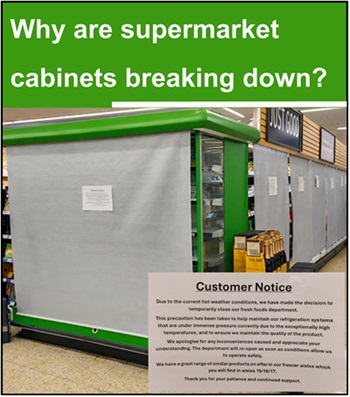
The warm weather in the UK last week resulted in multiple news articles on supermarket cabinets being out of operation or having restricted access (for example night blinds pulled down). At RD&T we have been regularly contacted by the media (see links below) to help explain why so many supermarkets were affected in the current heatwave.
Compared to 2022 which had the warmest temperature ever recorded in the UK (40.3°C in Coningsby on the 19th July) the temperatures were slightly lower (37.7°C at Lingwood, in Norfolk). However, there were extensive reports in the media of supermarkets experiencing issues with operation of cabinets, much more than in 2022. So, why was this? Was it that ambient temperatures were on average higher, night time temperatures were higher (and so plant had less chance to recover) or something else?
Looking at the information from the UK Met Office it is clear that mean temperatures were higher in June 2026. In England, June was the warmest month on record, with a mean of 17.1°C. This surpassed the previous record set in 2025 and was nearly 3°C above the long-term average. In addition, the heat was combined with high humidity which may have had some impact on refrigerated cabinets (especially those where there was no air conditioning in the store). These conditions led to exceptionally high daytime temperatures and unusually warm nights. The UK recorded a new high daily minimum temperature of 23.5°C and there were frequent ‘tropical nights’ (where temperatures overnight remained above 20°C).
The weather data confirms that temperatures were high in June 2026 and often well above the design temperature for supermarket refrigeration systems. In recent work for the Climate Change Committee, supermarkets told us that approximately 99% of the existing supermarket infrastructure is designed for 32°C. Therefore, it is not surprising that refrigeration plant failed or plant needed to be unloaded (load removed from the plant by shutting down cabinets) to cope with the ambient temperatures encountered in June. Combined with reported maintenance issues such as dirty condensers, air recirculation around condensers and warmer roof areas where condensers are situated, this resulted in many refrigeration plants not being able to cope.
So, to answer the question on what caused so many reported incidents of supermarket refrigeration being out of operation in June 2026, it seems probably to be a combination of warm days and nights as well as maintenance issues. Although new supermarket plant is being specified to cope with higher ambient temperatures this may not cope with events that once occurred every ten or twenty years now occurring more regularly. One initiative that is working to provide design information for all refrigeration plant operators is the Institute of Refrigeration (IOR) Code of Practice. This code (involving RD&T’s Judith Evans and Alan Foster as well as a number of professional organisations, industry and academics) is under final development and will advise operators of plant on design specifications, how to adapt plant for future ambient conditions and what mitigations are achievable.
To discuss any of this further please get in touch with Alan Foster (alan.foster@rdandt.co.uk).
Media involving RD&T:
Alan Foster was interviewed on BBC Points West and interview broadcast on 02.07.26.
Alan Foster interviewed for BBC Bristol radio, BBC West and Heart Radio West Country on 01.07.26.
Information is also available via BBC news:
UK heatwave leave fridges struggling to 'deal with the heat' - BBC News
Can our home and supermarket fridges cope with heatwaves? - BBC News