Latest PFAS news
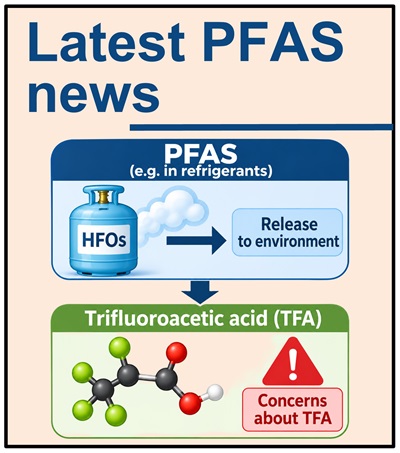
Polyfluoroalkyl substances (PFAS) are synthetic chemicals that have been in use since the 1950s. They are highly resistant to heat, water, and oil, making them useful for a variety of applications, including packaging, clothes, cookware and carpets. PFAS substances are persistent in the environment and do not break down easily and so can remain there for long periods of time. This is why they are often referred to as forever chemicals. In particular, concerns have been raised about the PFAS trifluoroacetic acid (TFA) which is generated when certain refrigerants, in particular hydrofluoroolefins (HFOs) are released into the atmosphere.
A potential ban on PFAS was proposed in 2023 by five European countries who made a proposal to the European Chemicals Agency (ECHA) for a broad ban based on concerns for human health and the environment. This was proposed to cover manufacture, placing on the market and use. A transition period was suggested with potentially time limited or unlimited derogations on specific uses.
On 19th November 2026 the ECHA Committee for Socio-Economic Analysis (SEAC) adopted a final opinion supporting an EU-wide restriction on PFAS under the Registration, Evaluation, Authorisation and Restriction of Chemicals (REACH, Regulation (EC) No 1907/2006). SEAC is stated as supporting a ban with some use-specific derogations. Currently these include:
- use-specific derogations where justified by the available evidence;
- transition and derogation periods that allow time to develop and implement alternatives and compliance with any additional conditions; and
- time-limited derogations for certain sectors, pending further evaluation.
The SEAC opinions will now be finalised and sent with the Committee for Risk Assessment’s (RAC) opinions to the European Commission. The document will be published on the ECHA’s web site (ECHA). Based on these opinions the Commission will propose restrictions for discussion and vote in the REACH Committee, composed of representation from EU Member States.
Although this is an ongoing issue it seems increasingly clear that refrigerants containing PFAS are likely to have a limited life. This includes the HFOs used in modern refrigeration systems, as well as many other refrigerants such as R-134a, R-125, R-143a and R-245fa and their blended refrigerants, e.g. R407A/C, R410A, R448A, R449A/C, R452A/B, R454B/C, R455A and R513A. Notwithstanding derogations and delays in implementation the wise decision if designing new refrigeration system is to move to a natural refrigerant (e.g. hydrocarbons, ammonia or CO2) that will have longevity and will not be banned either by F-gas regulations or PFAS bans.
At RD&T we are increasingly working with natural refrigerants, mainly either hydrocarbons or CO2. These refrigerants have some challenges (flammability, or trans-critical operation and high pressure) but properly managed and handled are excellent options (higher efficiency) for commercial, professional and domestic systems. If you would like help designing, developing or testing systems with natural refrigerants then please do get in touch with Judith Evans (j.a.evans@rdandt.co.uk).