Will new pesticide PFAS classification impact refrigerants?
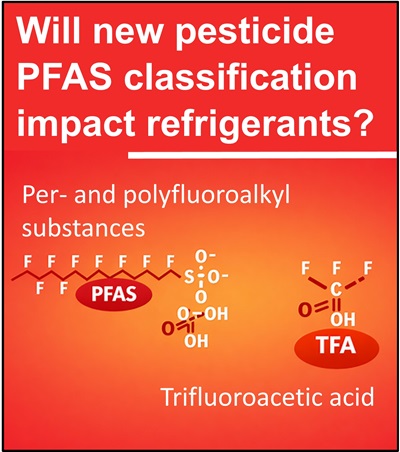
The European Chemicals Agency (ECHA) has recently classified trifluoroacetic acid (TFA) in pesticides as being toxic and that it "may damage the unborn child" and "may impair fertility". The committee also supported classifying TFA as persistent, mobile and toxic (PMT) and a very persistent and very mobile (vPvM) substance (meeting minutes).
TFA is a persistent per- and polyfluoroalkyl substance (PFAS) chemical. PFAS chemicals are a group of over 10,000 synthetic chemicals widely used since the 1950s to make products non-stick, waterproof, and stain resistant. They are often called "forever chemicals," as they do not easily degrade in the environment and accumulate in the human body.
Although the ECHA classification applies to pesticides, it may signal the potential for other groups of PFAS chemicals to be assessed. For example, TFA is also a breakdown product from PFAS-containing F-gases. Chemicals such as R134a, R1234yf, R1234ze(E) and R1233zd(E) which are used as refrigerants, propellants or blowing agents can escape into the atmosphere and breakdown to produce TFAs. Recent work published by the University of Bristol[1] has modelled R134a and R1234yf breakdown in the atmosphere. They found increasing TFA breakdown products from R1234yf (which is now commonly used in car air conditioning). Global emissions of R134a were found to be 22 times higher than those from R1234yf. However, they stated that “R1234yf may already be generating up to three-quarters as much TFA globally as HFC-134a and may already be responsible for greater TFA deposition across Europe”.
So, does this mean that some refrigerants will be affected by future changes in classification? The Registration, Evaluation, Authorisation and Restriction of Chemicals (REACH) ECHA is currently considering this matter with a possible enactment of regulations in 2028.
Alternatives to PFAS refrigerants are available for almost all cooling applications and “natural” refrigerants such as R290, R600a (both hydrocarbons), R744 and R717 are already widely used. These refrigerants require some care in their application as they operate at high pressures, are toxic or flammable. However, these issues are manageable and there is already widespread application of hydrocarbon refrigerants in small domestic, professional and commercial appliances. R744 (CO2) is increasingly used in larger supermarket refrigeration systems and R717 (ammonia) has been used in industrial refrigeration for many years. At RD&T we have a capability to test the performance of equipment using R744 or hydrocarbons. We can also test the flammable safety of hydrocarbon equipment according to the relevant test standard (IEC 60335). For further information on testing or to discuss this issue further please get in touch with Alan Foster (alan.foster@rdandt.co.uk).
[1] https://www.bristol.ac.uk/news/2026/july/replacement-climate-friendly-car-.html